


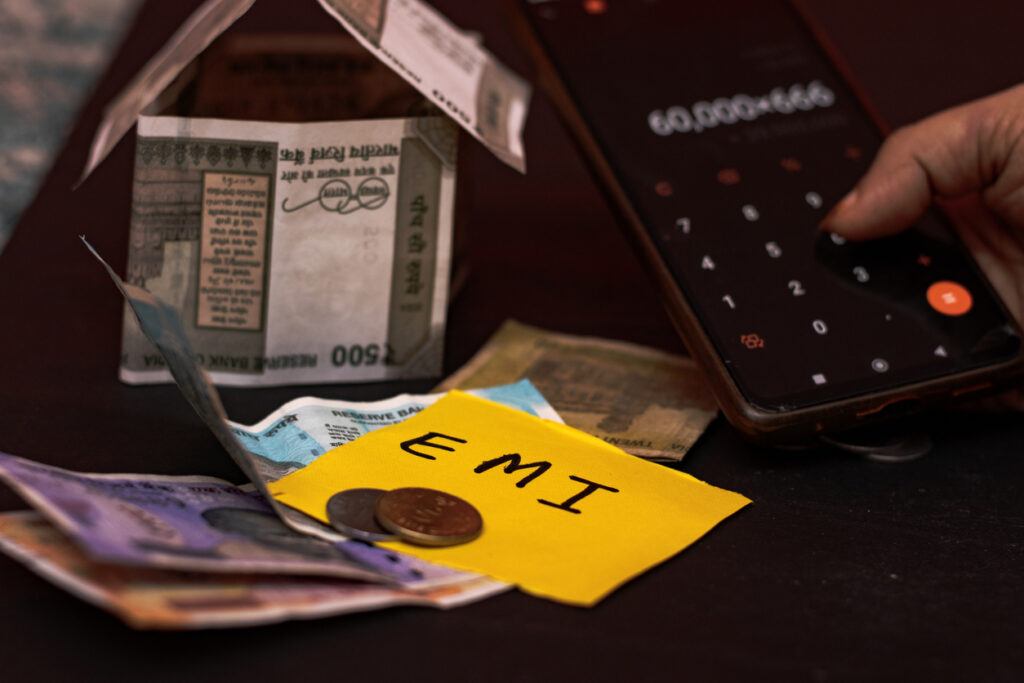
Moving to a big city, finding your dream job, staying in an apartment in an upscale building, or driving your dream car is all you have wanted for a long time. And these dreams have slowly come to fruition, but now you realise they come at a cost.
Your home loan EMI, car loan EMI, and personal loan EMI to furnish the house, as well as credit card payments, are the costs. These EMI payments all but drain your bank account by the 10th of each month. This is the EMI saturation point, and it’s the reality for millions of urban Indians like you.
Defining the EMI Saturation Threshold
The EMI saturation point is not a technical term from a finance book. When your fixed monthly obligations, such as home loans, vehicle loans, personal loans, or credit card payments, eat up a significant portion of your income, leaving you little or no money to save or invest, it is called EMI saturation.
If you live in a big city or metro, there is a good chance you are paying over 50-60% of your salary in EMIs alone. And then there are groceries, commute expenses, kids’ school fees, etc. When that is paid, there is hardly anything left for savings or investment.
When you reach this point financially, you have hit your financial saturation point.
How Do You Get There?
Financial saturation hardly ever comes from a single choice; it accumulates gradually. It usually starts with a home loan, because paying high rent feels like a waste of money. Now that EMI is a long-term commitment. Once your house is secured, you need appliances and furnishings, and often, you either take a personal loan or swipe your credit card and put the charge on EMIs for convenience.
Then you need a car for your office commute, and that is another large EMI. From time to time, you either need a new phone, a laptop, the latest smart television, etc. And before you know it, you have reached your EMI saturation point.
Each of these purchases is important and a sensible choice, but when this need is addressed at the same time, they put you in a financial cage of sorts.
Reset, Rebuild, Recover
The simple fact is that every rupee you pay toward an EMI is a rupee that cannot grow your savings through compounding. Before you take on any loans, make sure you are using them for the right reason. Here’s how you can do it:
Get visibility on your outgoing
Your primary objective should be visibility. Make a list of every EMI you pay, including the balance principal due, rate of interest, and remaining tenure of your loan. You need to know how much you owe and how long you have to pay that amount.
Prioritise expensive debt
Sort your debts according to the interest rate you pay. If you have a home loan at 8.5% and a personal loan at 14%, it’s an easy decision to choose to pay off the personal loan. Your home loan also includes tax benefits under Section 80C of the Income Tax Act.
Use extra money wisely
If you receive an incentive or an inheritance, don’t push yourself to upgrade your lifestyle. Use it to pay off a high-interest loan. Eliminating an 18% loan provides a guaranteed “return” that outperforms most market-based investments in the short term.
Make smart financial choices
Always evaluate your financial choices, whether they are for your car, home, or appliances. Do you use your car enough, or could you have managed your occasional use with cabs? Is your mortgage right sized in comparison to your earnings, or did you take the highest limit your bank offered to buy a home? Don’t take high loans or exceed limits because it’s possible.
Invest whatever you can
After you manage to pay off your EMIs, use that money to invest in SIPs. Also, remember that interest paid to banks is money that you will never see again. Instead, try to save money first and then buy what you need. You can assign goals and invest through mutual funds (long and short-term) for your purchases instead of taking a loan. Invest in short-term funds for expenses such as renovations and appliances, and in long-term funds for hefty down payment for buying a house.
Instead of paying mortgage of ₹1,00,000 over 20 years, it might be better to pay rent of ₹40,000 and invest the rest in a SIP. This could lead to a much higher net worth.
Here’s a small table showing how much you can save.
| Monthly Investment in Rupees | 60,000 |
| Expected ROI | 12% |
| Duration | 10 years |
| Total Invested | 72,00,000 |
| Estimated Returns | 62,42,153 |
| Total Returns | 1,34,42,153 |
Conclusion
It’s important to understand that debt is not inherently bad. Too many EMIs paid for too long at a high rate is the problem because it doesn’t allow your money any room to grow. Focus on keeping your fixed debts low enough so that you can consistently invest, build an emergency fund, and still live a good life today.
The money you earn is the most effective wealth-building instrument you have. Use it wisely.